Repair, Reuse and Restore: Reducing Waste in Scotland’s Traditional Buildings
Scotland’s historic buildings are an important part of the country’s architectural and cultural heritage. From sandstone tenements in Edinburgh and Glasgow to Victorian villas in Stirling and traditional cottages throughout rural Scotland, these properties represent generations of craftsmanship and the extensive use of natural materials.
However, the importance of preserving existing buildings extends beyond architectural heritage. Repairing, maintaining and reusing traditional materials can also help reduce construction waste, conserve resources and avoid some of the environmental impacts associated with manufacturing replacements.
As Scotland works towards a more circular economy, the principle of repairing rather than automatically replacing deserves greater attention.
The Environmental Cost of Construction Waste
Construction and demolition activities produce a substantial proportion of Scotland’s waste.
According to the Scottish Government’s Circular Economy and Waste Route Map to 2030, construction and demolition accounted for 4.6 million tonnes of waste in 2022.
Although much of this material is recycled, preventing unnecessary waste in the first place is an important environmental objective.
Traditional buildings offer considerable opportunities for waste prevention because many original components were designed to be maintained and repaired.
Timber windows, internal doors, floorboards, shutters, stonework and other architectural features can often remain serviceable for decades when properly maintained.
The decision to repair an existing component rather than replace it can reduce demand for new raw materials, transportation, packaging and waste disposal.
Understanding Embodied Carbon in Existing Buildings
Embodied carbon refers to greenhouse gas emissions associated with producing, transporting, installing, maintaining and disposing of building materials.
When an existing timber window is removed and replaced, the environmental consequences extend beyond the disposal of the old window.
New materials must be sourced, processed, manufactured and transported. Installation may require additional components, while the removed materials must be managed as waste.
Retaining an existing window can avoid some of these impacts.
However, repair is not automatically the lowest-carbon solution in every circumstance. The extent of damage, materials required, future maintenance and long-term energy performance should all be considered.
A responsible approach examines the whole life of the building component rather than focusing solely on its initial purchase price.
Traditional Timber Windows: A Practical Example
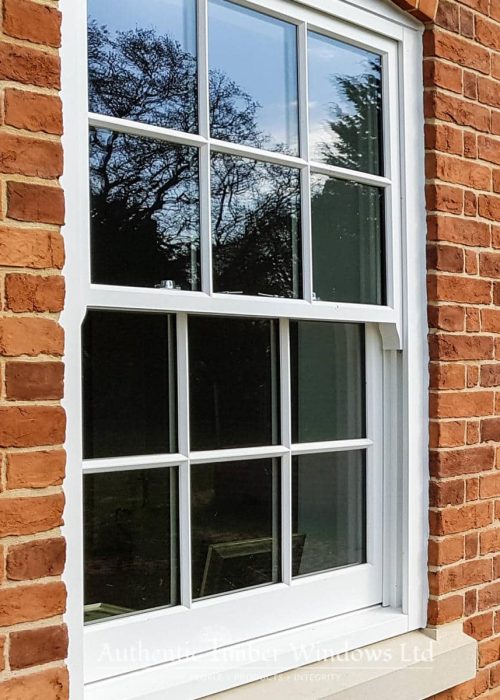
Scotland has a substantial stock of traditional timber sash and case windows, particularly in properties constructed during the eighteenth, nineteenth and early twentieth centuries.
These windows frequently incorporate durable timber, traditional joinery techniques and components that can be repaired individually.
Common problems include:
- Broken sash cords and worn pulleys.
- Localised timber decay around sills and bottom rails.
- Deteriorating glazing putty and external sand mastic.
- Sticking or poorly balanced sashes.
- Draughts caused by worn beads and gaps.
- Deteriorated paintwork exposing timber to moisture.
In many cases, these defects do not justify replacing the entire window.
Decayed timber can sometimes be removed and replaced with carefully matched sections. Sash cords can be renewed, moving parts serviced and glazing repaired while retaining the original window structure.
Historic Environment Scotland recommends retaining and improving traditional sash windows wherever practical, recognising their durability and architectural significance.
Improving Energy Efficiency Without Unnecessary Replacement
One common reason for replacing traditional windows is concern about heat loss.
However, replacement is not the only available solution.
Traditional sash windows can often be improved through a combination of repairs and sympathetic energy-efficiency measures.
Draught proofing can reduce uncontrolled air leakage around moving sashes while preserving their original appearance.
Secondary glazing can improve thermal and acoustic performance without requiring the removal of historic window frames.
Traditional timber shutters can also help reduce heat loss, particularly overnight.
These measures should be considered alongside the building’s ventilation requirements, moisture behaviour and any applicable conservation restrictions.
The objective is to improve comfort and energy performance while retaining valuable existing materials.
The Importance of Specialist Conservation Skills
Successful repair depends on understanding how traditional buildings were constructed.
Historic properties often incorporate materials and techniques that differ significantly from modern construction.
Inappropriate repairs can introduce moisture problems, accelerate timber decay or damage architectural details.
Specialist craftspeople can assess whether components are suitable for repair, identify compatible replacement materials and retain original fabric wherever reasonably possible.
For example, The Sash and Case Window Company undertakes traditional timber window restoration, repairs and draught proofing across Central Scotland. Its conservation-led approach provides a practical example of how existing building components can be maintained rather than automatically discarded.
Disclosure: This business is referenced as a practical example of traditional window restoration. The contribution should identify any commercial or ownership relationship with the author or publisher.
Repair and Reuse Beyond Windows
The principles of building conservation extend to many other components.
Traditional Timber Doors
Original timber doors can often be repaired through careful joinery, replacement of damaged sections and refurbishment of existing ironmongery.
Wooden Floors
Historic floorboards may be suitable for lifting, repairing, refixing and refinishing rather than complete replacement.
Natural Stonework
Traditional stone buildings can benefit from compatible repairs that retain existing masonry and avoid unnecessary demolition.
Architectural Joinery
Skirting boards, shutters, staircases and decorative timberwork can frequently be preserved through skilled maintenance and restoration.
Each retained component represents materials that do not immediately need to be manufactured again.
Supporting Scotland’s Circular Economy
A circular economy aims to keep products and materials in use for longer, reducing unnecessary consumption and waste.
Building repair and conservation fit naturally within this approach.
The Scottish Government’s circular economy policies recognise the importance of extending the useful life of existing buildings and increasing the reuse of construction materials.
Encouraging repair also helps sustain traditional craft skills and local businesses capable of maintaining Scotland’s historic building stock.
These skills are valuable not only for heritage protection but also for creating a more resource-efficient construction sector.
Practical Steps for Property Owners
Homeowners and building managers can make more informed decisions by adopting a repair-first approach.
Before replacing traditional building components, they should consider:
- Whether the existing materials are structurally sound or capable of localised repair.
- Whether maintenance could resolve the underlying problem.
- Whether energy performance can be improved without complete replacement.
- Whether replacement would damage the building’s historic character.
- Whether specialist conservation advice is required.
- Whether listed building consent or other permissions may be necessary.
A proper condition assessment is often the best starting point.
Conclusion: Maintaining What Scotland Already Has
Protecting Scotland’s environment involves more than developing new technologies and materials. It also means making responsible decisions about the resources already incorporated into our buildings.
Traditional properties contain substantial quantities of timber, stone, glass and other materials that have already been extracted, manufactured and transported.
Where those materials remain serviceable, maintaining and repairing them can help reduce unnecessary waste and conserve resources.
By supporting skilled conservation, sympathetic refurbishment and practical energy improvements, Scotland can preserve its architectural heritage while contributing to a more sustainable built environment.
Repair, reuse and restore should be central considerations whenever traditional building components are assessed for replacement.